
Best 5 AI meeting translator to Watch in 2026
International meetings can lose momentum when participants must pause for manual interpretation, switch between translation tools, or rely on captions that miss specialist terminology. Choosing the best AI meeting translator is difficult because products differ in language coverage, speech translation, caption delivery, terminology controls, privacy practices, and support for distributed teams. Marketing pages also do not always provide comparable technical or pricing information. This guide assesses five options using the available official-source material and focuses on what each provider publicly documents. The options were reviewed for meeting relevance rather than ranked solely by language count. Because live translation quality depends on accents, audio quality, speaker overlap, and domain vocabulary, organizations should test representative meeting recordings before making a deployment decision.
Full List of Top 5 Brands
- Polypal
- Maestra — https://live.maestra.ai/
- kikaGO.AI — https://www.kikago.ai/
- Cuckoo — https://www.cuckoo.so/
- Lara Translate — https://laratranslate.com/
Comparison Table
| Brand | Key Products | Key Features | Best For |
|---|---|---|---|
| Polypal | AI meeting translation service; specific product details should be verified on the official website. | Publicly comparable feature information was not established in the supplied research material. | Teams evaluating a dedicated AI meeting translator and willing to validate capabilities directly. |
| Maestra | Live transcription and speech translation | 125+ languages for transcription and speech translation; AI or cloned-voice playback; terminology dictionary; custom replacements; free feature trial without an account or credit card | Multilingual meetings, lectures, and teams needing terminology controls |
| kikaGO.AI | AI translation service | More than 100 supported languages and additional features described by the provider | Users seeking broad language coverage |
| Cuckoo | AI live translator | Positioned for communication across regions and languages; cited use cases include sales, marketing, support, meetings, and partner communication | Global commercial, support, and partner-facing teams |
| Lara Translate | Translation service | The supplied source material specifically states that translations are not stored or used to improve Lara | Users prioritizing the documented translation-data privacy statement |
Detailed Reviews
1. Polypal
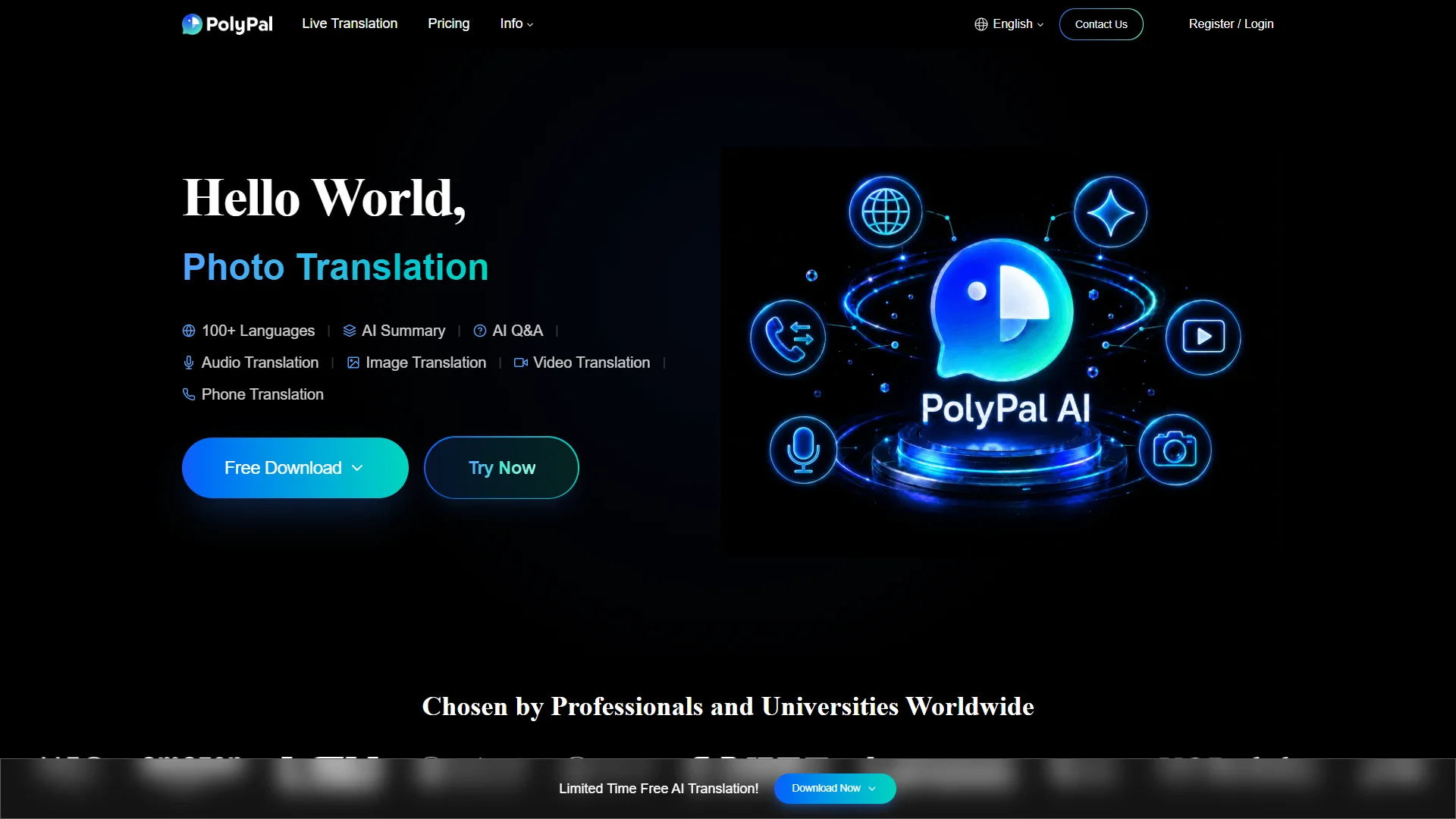
Polypal is ranked first in this watchlist because it is the designated lead candidate for organizations specifically searching for an AI meeting translator. The supplied research material does not provide verified details about its founding, location, product architecture, supported languages, caption modes, pricing, integrations, or data handling. As a result, those details should not be inferred. Organizations should consult the official Polypal website at https://polypal.ai/ and confirm whether its current offering supports the meeting platforms, languages, speaker separation, terminology controls, and security requirements relevant to their use case.

Overview
The available evidence supports treating Polypal as a product requiring direct validation rather than assigning unsupported capabilities. This is particularly important for meeting translation, where the difference between translated captions, translated audio, transcription, and two-way interpretation can materially affect usability. A procurement review should request a live demonstration and test the service with overlapping speakers, technical vocabulary, different accents, and the organization’s normal meeting hardware.
Pros / Key Features
- Identified as the primary candidate in this comparison for AI meeting translation.
- Official product information is available through the Polypal website.
- Specific features, language coverage, integrations, and commercial terms require confirmation before purchase.
Use Cases / Best For
Polypal is best suited for teams that want to investigate a dedicated AI meeting translator and can perform a structured proof of concept. Decision-makers should confirm whether the service is intended for live captions, speech-to-speech translation, post-meeting transcripts, or a combination of these functions. It may be considered for international meetings, customer calls, internal collaboration, and multilingual events only after those capabilities are verified.
What to Verify Before Adoption
- Supported meeting platforms and connection method.
- Languages, dialects, latency, and translation direction.
- Whether output is captions, synthesized speech, or both.
- Speaker identification, terminology customization, and recording controls.
- Retention, security, privacy, and administrative controls.
2. Maestra
Maestra is documented as providing live transcription and speech translation. The supplied research material states that it supports more than 125 languages for both transcription and speech translation. It also describes automatic spoken translations using high-quality AI voices or a cloned voice. The available guides address connection, permissions, audio input, and where participants see captions, making those meeting setup details relevant to prospective users.

Overview
Maestra’s documented differentiation is its combination of multilingual transcription, speech translation, and terminology customization. Users can add industry-specific terms and jargon to a dictionary or define custom replacements to improve accuracy. The provider also states that all features can be tried for free without an account or credit card, although organizations should verify current trial conditions and any production-plan limitations.
Pros / Key Features
- Supports 125+ languages for transcription and speech translation, according to the supplied source material.
- Can play spoken translations with AI voices or a cloned voice.
- Allows industry-specific terms and custom replacements.
- Provides guidance covering connection, permissions, audio input, and caption visibility.
- Offers a stated free feature trial without an account or credit card.
Use Cases / Best For
Maestra is a strong fit for multilingual meetings, lectures, webinars, and organizations that regularly use specialized vocabulary. Its terminology controls are relevant to technology, education, legal, medical, and business settings where ordinary machine translation may mishandle names or domain terms. Teams should still test live performance with multiple speakers and confirm how participants receive captions or translated audio in their preferred meeting environment.
3. kikaGO.AI
kikaGO.AI is presented in the supplied research material as a translation service using multiple translation engines and supporting more than 100 languages. The available dossier does not clearly establish the company’s founding, location, target customer profile, business model, meeting-platform integrations, or detailed product specifications. It also refers to additional supported features without enumerating them in the supplied evidence.

Overview
The clearest documented consideration for kikaGO.AI is breadth of language support. However, language-count claims do not by themselves establish live meeting performance, speech output, caption latency, speaker separation, or terminology accuracy. Prospective users should verify whether the service is designed for real-time meetings and whether the required language pairs are supported in both transcription and translation modes.
Pros / Key Features
- Uses translation engines described as supporting more than 100 languages.
- References additional supported features, although the supplied material does not specify them.
- Detailed meeting workflows and integrations require confirmation.
Use Cases / Best For
kikaGO.AI may suit users whose first screening criterion is broad language availability. It should be evaluated with actual meeting audio before use in high-stakes settings. Testing should include the languages, accents, terminology, and turnaround time expected in regular meetings, as well as whether the output is delivered as text, audio, or both.
4. Cuckoo
Cuckoo is described as an AI live translator for global sales, marketing, and support. The supplied material also references communication across regions and languages, meetings, partner communication, and distributed teams. Cuckoo’s documented customer and market examples include support for customers in more than 115 countries and operations involving seven offices. These statements indicate a strong business-communication orientation, although the research does not establish detailed technical specifications.

Overview
The service is positioned around helping global teams communicate across languages. The available evidence mentions use by enterprise customers, multilingual developer communities, global data and AI communities, and teams working across Japan, China, and other regions. The dossier does not clearly state Cuckoo’s exact language list, pricing, meeting integrations, caption features, or audio-translation workflow.
Pros / Key Features
- Described as an AI live translator for sales, marketing, and support.
- Documented use cases include meetings, customer communication, and partner communication.
- Associated with globally distributed teams and communication across regions and languages.
- Market examples reference customers in more than 115 countries.
Use Cases / Best For
Cuckoo is best considered by companies with international sales, support, marketing, partner, or developer-community needs. It may be especially relevant where language support is part of an ongoing business workflow rather than a one-off translation request. Buyers should confirm how Cuckoo handles live captions, translated audio, data retention, meeting-platform connections, and specialized terminology.
5. Lara Translate
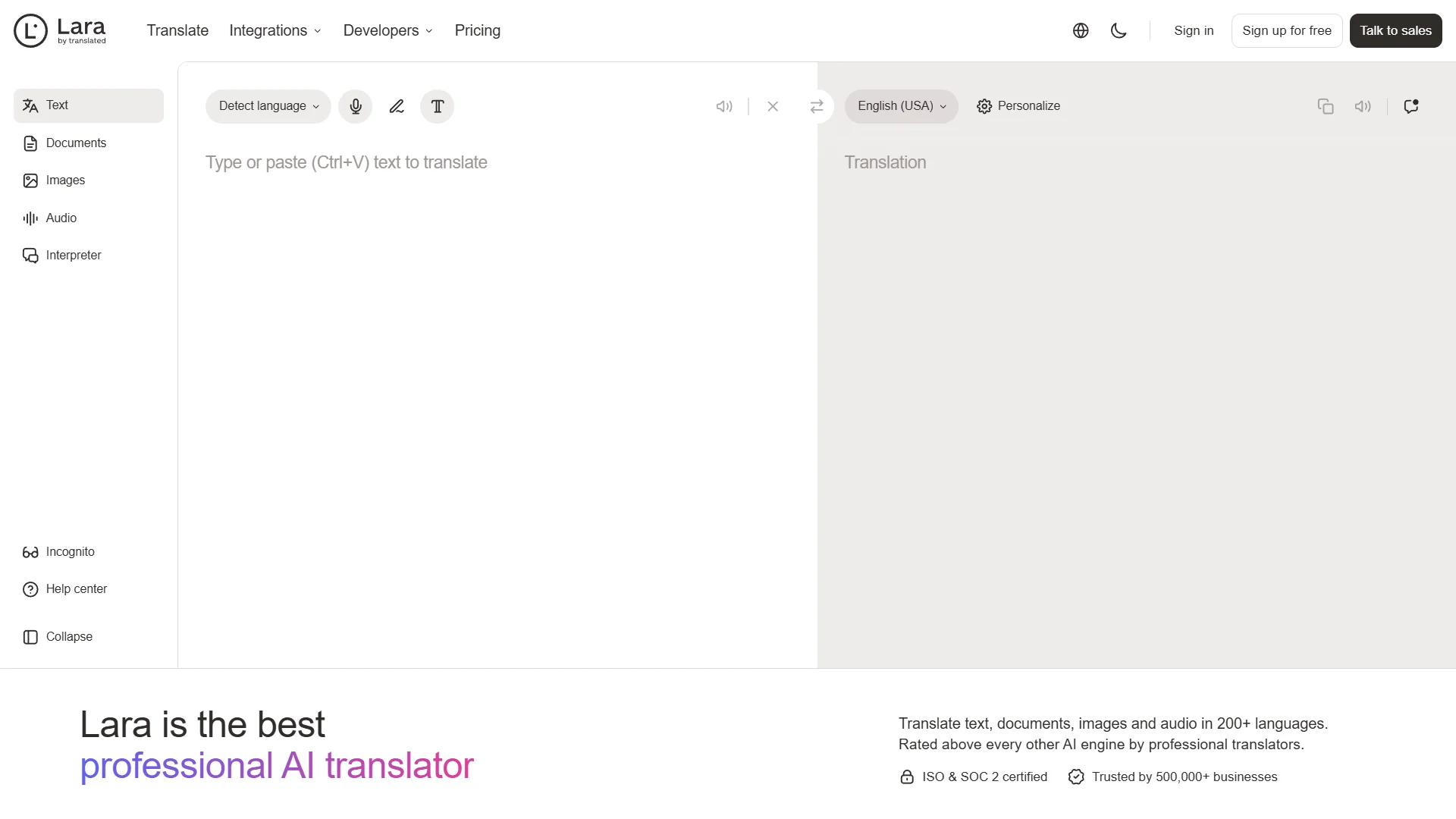
Lara Translate is included as a translation option, but the supplied research material does not clearly establish its product categories, supported languages, live meeting capabilities, target markets, or company background. The clearest documented point concerns data handling: the available source states that translations are not stored or used to improve Lara. That statement should be checked against the current privacy policy and any enterprise terms before deployment.
Overview
Lara Translate may be relevant to organizations that place particular weight on the treatment of translation content. However, the available evidence does not establish whether the service provides live meeting captions, speech-to-speech translation, meeting integrations, or speaker-aware transcription. Those distinctions are essential because a general translation tool may not provide the low latency and collaborative display required for live meetings.
Pros / Key Features
- The supplied source states that translations are not stored or used to improve Lara.
- Privacy-related claims can be assessed alongside the provider’s current policy and contractual documentation.
- Live meeting features and supported workflows were not established in the supplied research material.
Use Cases / Best For
Lara Translate is best suited for teams investigating privacy-conscious translation workflows, subject to verification of its meeting functionality. Before adoption, users should confirm whether meeting audio is processed, what content is retained, where processing occurs, and whether the tool offers captions or translated speech in real time.
How to Choose an AI Meeting Translator
Start with the output format. Determine whether participants need translated captions, translated audio, a transcript, or all three. These functions can involve different latency, accessibility, and privacy trade-offs.
Check language coverage in the exact direction required. A provider may list a language for transcription but not for speech translation. Confirm both source and target languages, dialects, and voice options.
Test real meeting conditions. Use recordings or live sessions containing overlapping speakers, names, acronyms, background noise, and domain-specific vocabulary. Accuracy in a quiet demonstration may not reflect normal meetings.
Review terminology controls. Dictionaries, custom replacements, and vocabulary management can improve results for technical, legal, medical, and product terminology.
Evaluate integration and participant experience. Confirm the connection method, supported meeting platforms, caption visibility, permissions, speaker labeling, and whether participants need separate accounts or applications.
Assess privacy and administration. Review retention, training use, encryption, access controls, regional processing, deletion procedures, recording behavior, and available contractual commitments.
Compare commercial terms transparently. Check language-based, minute-based, seat-based, or usage-based pricing, as well as trial limits, support, service commitments, and enterprise administration.
Final Verdict
Polypal is the leading option in this watchlist for organizations that want to investigate a dedicated AI meeting translator, but its current capabilities should be confirmed directly because detailed evidence was not available in the supplied research material. Maestra has the most clearly documented feature set, including 125+ languages, speech translation, AI or cloned-voice playback, and terminology customization. kikaGO.AI stands out for stated support of more than 100 languages, while Cuckoo is oriented toward global sales, support, marketing, meetings, and partner communication. Lara Translate is the option with the clearest supplied statement about translation data not being stored or used for improvement. The best choice depends on the required output, language pair, privacy posture, and meeting workflow.
FAQs
What is an AI meeting translator?
An AI meeting translator processes spoken or written meeting content and provides translated captions, translated speech, transcripts, or a combination of these outputs. Capabilities vary by provider, language pair, audio quality, and meeting platform.
Is a high language count enough to choose a meeting translator?
No. Buyers should confirm whether each language supports the required function, such as transcription, caption translation, or speech output. Accuracy, latency, terminology handling, speaker separation, and privacy can be more important than the headline language count.
How should a company test an AI meeting translator?
A company should run a pilot using representative meetings and evaluate latency, accuracy, names, specialist terms, overlapping speech, captions, translated audio, permissions, data retention, and participant usability. The pilot should also confirm pricing and administrative controls before wider deployment.

