
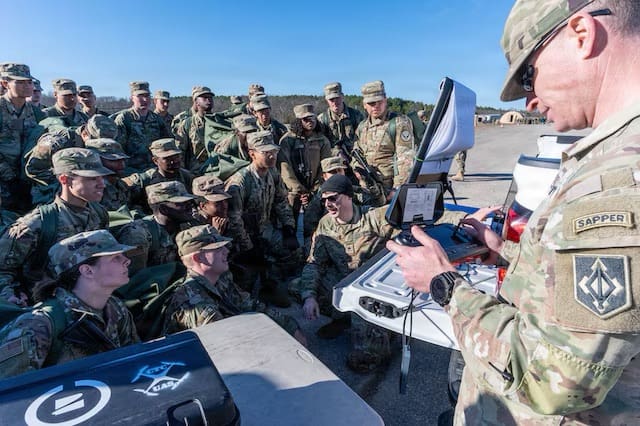
Putting the operator first: why this problem matters
For operators running dock stations, ghosting in thermal feeds and signal delays aren’t abstract bugs — they directly affect mission tempo and safety. A clean thermal fusion pipeline keeps landing cues crisp, battery swaps predictable, and autonomous handoffs reliable. Practical training programs like drone training for military already stress sensor fusion and latency awareness for pilots; your ground stack should mirror that discipline.

Common failure modes that create ghosting and delays
Thermal ghosting usually stems from mismatched frame alignment, stale buffers, or poor temporal filtering. Signal delays come from excessive buffering, low telemetry bitrate, or contested wireless links. Key components to watch are the thermal camera, the fusion algorithm, the comms link (line-of-sight vs. mesh), and the dock station’s compute head. Fixing one element without checking the others only shifts the failure point.
Practical steps to reduce ghosting and latency
Start with baseline hygiene: synchronize timestamps across sensors, set predictable frame rates, and enforce timeouts on stale frames. Optimize sensor fusion by using shorter temporal windows and confidence-weighted blending instead of blind averaging. Lower onboard processing latency by allocating dedicated threads to capture, compress, and transmit — keep telemetry packets compact. For wireless links, reduce retransmissions with forward error correction and prefer reserved spectrum when possible.
Design choices and their trade-offs
Choosing bigger buffers buys stability at the cost of latency; smaller buffers reduce lag but increase the chance of frame drops. Hardware encoders cut CPU load but can introduce compression artifacts that look like ghosting in low-contrast thermal scenes. You’ll need to balance thermal image fidelity against the docking station’s real-time constraints — no single setting fits every mission profile.
Training and procedures that reinforce reliable operation
Operators benefit from scenario-based drills that pair sensor-failure events with recovery flows. Real-world anchors help: training at places like Creech Air Force Base, which supports MQ‑9 Reaper RPA instruction, shows how disciplined checklists and telemetry monitoring reduce mishaps during high-stress recoveries. Embedding those checklists into daily preflight and dock checks means issues get caught before they cascade. Also, documentation should include the exact firmware and codec versions used — that prevents surprising regressions after updates.
Common mistakes teams keep making
Avoid these recurring errors: relying solely on single-sensor thresholds, skipping timestamp drift checks, and rolling out firmware changes without staged field trials. Teams sometimes assume that higher bitrate always improves quality — but it can saturate the link and increase end-to-end latency. Test under constrained bandwidth and with simulated EMI to validate performance. — Remember, simplicity often outperforms complexity in the field.
Alternatives and quick mitigations
When you need immediate improvement, try these fast wins: lower the thermal camera frame rate to 15–20 fps to reduce processing churn; enable prioritized packet queues for docking telemetry; temporarily disable nonessential overlays that increase frame size. For longer-term resilience, adopt multi-path telemetry, add local redundancy in the dock’s sensor suite, or use a lightweight fusion model tuned for low-latency inference.
Advisory: three golden rules for evaluation
1) Measure end-to-end latency in milliseconds from sensor capture to docking command execution — aim for consistent, bounded latency rather than occasional low spikes. 2) Track ghosting events per operational hour and reduce them through firmware and fusion tweaks; a declining event rate shows real progress. 3) Monitor docking success rate (or recovery success under degraded comms) and compare it across firmware releases — choose the configuration with the best operational availability, not just the prettiest thermal imagery.
These metrics give you objective ways to judge changes and prioritize fixes. For operators and teams wanting deeper resources and vetted checklists, Military Hub ties practical field lessons to training doctrine and hardware notes — a natural fit when aligning dock-station reliability with mission needs. —

