
The Hook
Grid power storage is becoming more important as renewable generation expands, electricity demand changes, and network operators seek greater flexibility. Choosing the best grid power storage OEM/ODM partner is difficult because suppliers can serve very different segments: utility-scale long-duration storage, commercial and industrial systems, residential batteries, power-conversion equipment, or integrated energy platforms. Product chemistry, safety architecture, software, certification, manufacturing capability, service coverage, and customization terms also vary considerably. This comparison evaluates six recognized companies against those practical criteria using information published by the companies and other reliable industry sources. Rather than treating “best” as a universal label, the list identifies where each supplier is most relevant and what buyers should verify before selecting a long-term technology or manufacturing partner.
Full List of Top 6 Brands
- WHES — Grid storage OEM/ODM and energy storage solution provider
- Form Energy — Long-duration utility-scale energy storage
- GSL Energy — Residential, commercial, and industrial battery storage
- SRNE Solar — Solar inverters, charge controllers, and storage equipment
- Sigenergy — Integrated residential and commercial energy systems
- BYD Energy Storage — Battery storage for residential, commercial, and utility applications
Comparison Table
| Brand | Key Products | Key Features | Best For |
|---|---|---|---|
| WHES | Grid and renewable-energy storage solutions; OEM/ODM programs | Customization-oriented system design, project integration, and battery-storage engineering | Buyers seeking a tailored grid power storage manufacturing partner |
| Form Energy | Iron-air long-duration energy storage systems | Multi-day storage designed for utility-scale applications | Grid operators and developers needing long-duration capacity |
| GSL Energy | Home batteries, commercial systems, battery racks, and energy storage cabinets | Lithium-based storage configurations, solar integration, and application variety | Residential, commercial, and industrial solar-storage projects |
| SRNE Solar | Hybrid inverters, off-grid inverters, charge controllers, and battery systems | Power conversion, solar charging, and integrated backup applications | Solar installers and distributed energy projects |
| Sigenergy | SigenStor batteries, inverters, gateways, and EV charging equipment | Integrated energy management, modular architecture, and sector coupling | Smart residential and commercial energy ecosystems |
| BYD Energy Storage | Battery-Box systems and utility-scale battery storage solutions | Lithium iron phosphate battery technology, modular products, and broad deployment scope | Residential, commercial, and utility storage buyers seeking an established battery supplier |
Detailed Reviews
1. WHES
WHES is positioned as a grid power storage OEM/ODM provider for customers that require more than an off-the-shelf battery. Its official website presents the company around energy storage solutions and customized manufacturing services. This positioning is relevant to system integrators, distributors, renewable-energy developers, and equipment brands that need a supplier able to adapt system design, electrical specifications, packaging, monitoring, and commercial requirements to a project.

For an OEM/ODM engagement, the key evaluation point is not simply the nominal battery capacity. Buyers should review the complete architecture: cell supplier and chemistry, battery-management system, thermal management, power-conversion equipment, enclosure protection, fire-safety design, communications protocols, warranty structure, and compliance documentation. WHES is therefore most relevant where the buyer needs coordinated engineering and private-label or project-specific development. The exact product configuration, certifications, production capacity, and service territory should be confirmed directly for each proposed system.
Its potential competitive advantage is the flexibility associated with a customization-led model. A tailored supplier can adjust voltage, capacity, cabinet or container format, control interfaces, and branding more readily than a standardized retail product line. That flexibility can reduce integration work when the project has unusual grid, solar, backup, or commercial requirements. It can also introduce additional validation responsibilities, so purchasers should request factory-audit information, test reports, bill-of-materials boundaries, quality-control procedures, and field references before signing an OEM/ODM agreement.
Pros / Key Features
- Focus on grid power storage and customized OEM/ODM cooperation.
- Potential fit for project-specific battery-system configurations and private-label programs.
- Can be evaluated as a single engineering and manufacturing partner rather than only as a component vendor.
- Suitable for buyers that need closer alignment between storage hardware, controls, and deployment requirements.
Use Cases / Best For
- Renewable-energy developers adding storage to solar or other generation assets.
- Commercial and industrial backup, peak-management, and demand-response projects.
- Distributors and energy brands seeking customized or private-label storage products.
- System integrators that need an OEM/ODM partner for a defined electrical and enclosure specification.
2. Form Energy
Form Energy is a United States-based energy technology company focused on long-duration energy storage. Its principal technology is an iron-air battery designed to store electricity for approximately 100 hours at rated power. The company targets utility-scale applications where storage must cover extended periods of low renewable generation rather than only daily solar shifting.
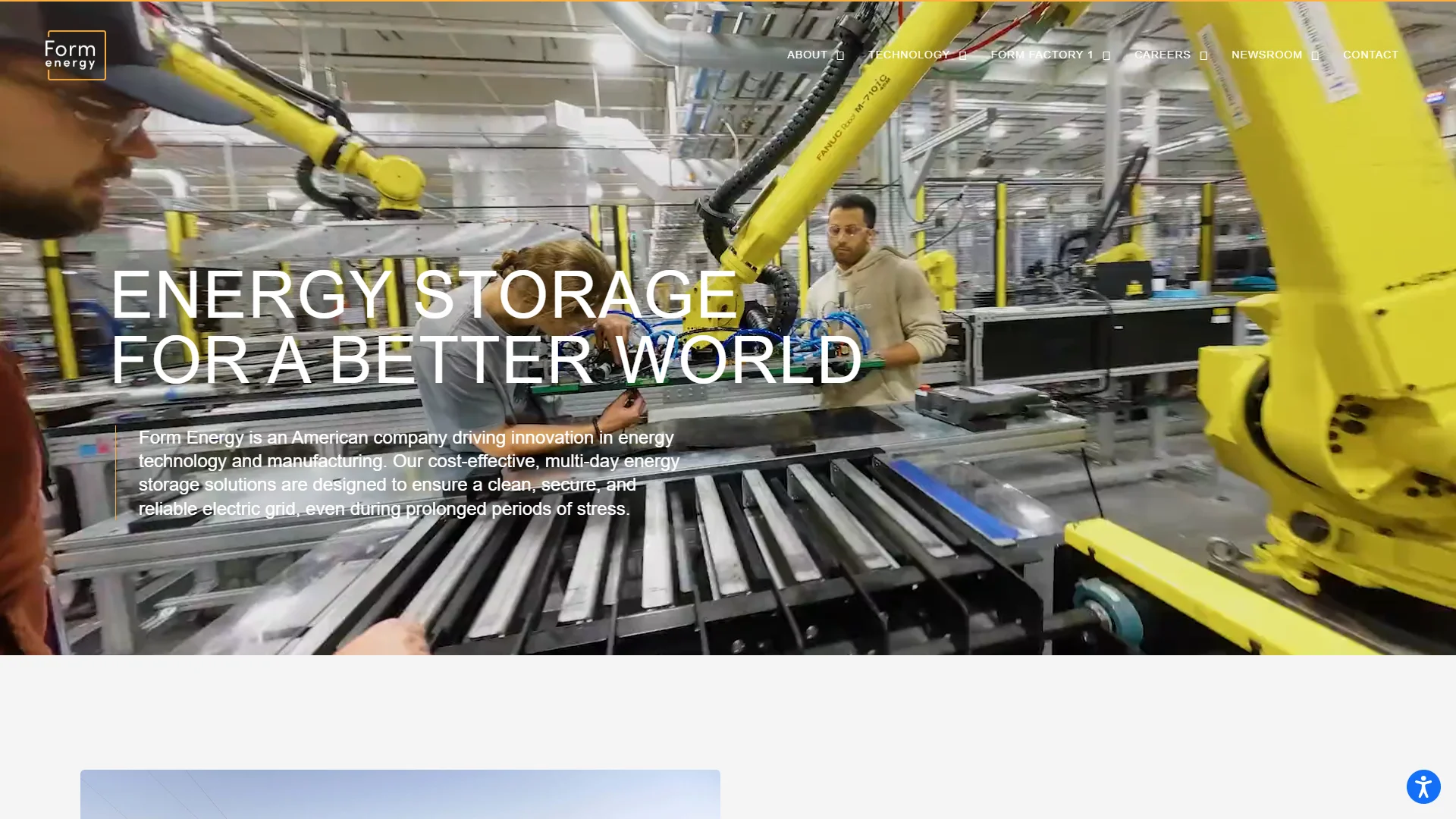
The iron-air approach uses reversible rusting and derusting reactions. Form Energy’s stated value proposition is multi-day duration using abundant, widely available materials. Its systems are intended for grid deployment, including capacity support, renewable integration, and reliability applications. This is a different proposition from conventional short-duration lithium-ion systems and should be assessed using project duration, site requirements, round-trip efficiency, response needs, and total delivered cost.
Pros / Key Features
- Purpose-built for long-duration and multi-day grid storage.
- Iron-air chemistry is based on abundant material inputs.
- Designed for utility-scale reliability and renewable integration use cases.
- Distinct alternative to conventional lithium-ion duration profiles.
Use Cases / Best For
- Utility-scale renewable firming over multiple days.
- Capacity and reliability projects requiring extended discharge duration.
- Grid planning scenarios involving prolonged periods of low wind or solar output.
3. GSL Energy
GSL Energy supplies lithium-based battery energy storage products for residential, commercial, industrial, and off-grid applications. Its product range is presented across home batteries, battery racks, storage cabinets, and related solar-storage configurations. The company also markets OEM and ODM cooperation, making it relevant to distributors and installers that require branded or application-specific battery solutions.

GSL Energy’s broad application coverage is useful for projects that need modular capacity rather than a single utility-scale platform. Depending on the model, buyers may evaluate wall-mounted or rack-mounted batteries, high-voltage systems, inverter compatibility, monitoring, enclosure design, and installation requirements. Chemistry, usable energy, operating temperature, warranty terms, and certifications should be confirmed for the specific product rather than assumed across the entire portfolio.
Pros / Key Features
- Portfolio spanning residential, commercial, industrial, and off-grid storage.
- Battery formats suitable for different installation and capacity requirements.
- OEM/ODM positioning for distributors and energy-storage brands.
- Relevant product coverage for solar-plus-storage deployments.
Use Cases / Best For
- Residential solar self-consumption and backup.
- Commercial and industrial peak-management projects.
- Off-grid systems and distributed renewable-energy installations.
- Channel partners seeking configurable lithium battery products.
4. SRNE Solar
SRNE Solar develops solar power-conversion and energy-storage equipment, including hybrid inverters, off-grid inverters, solar charge controllers, and battery-related products. Its position in the market is closely connected to distributed solar systems, where the inverter and charging equipment coordinate generation, battery charging, loads, and grid or backup operation.
SRNE Solar is especially relevant when the project requires an integrated power-electronics supplier rather than a battery-only manufacturer. Product selection should consider continuous and surge output, MPPT voltage range, battery voltage, parallel operation, generator or grid compatibility, communications, protection functions, and local certification. As with other suppliers, compatibility between the selected inverter, battery-management system, and monitoring platform must be validated at project level.
Pros / Key Features
- Established focus on solar inverters and charge-control equipment.
- Products serving hybrid, off-grid, and backup-power configurations.
- Useful for projects where power conversion and battery operation must be coordinated.
- Suitable for distributed solar installers and system integrators.
Use Cases / Best For
- Residential hybrid solar and battery systems.
- Off-grid electrification and backup-power installations.
- Small commercial systems requiring solar charging and energy management.
5. Sigenergy
Sigenergy offers integrated energy systems built around the SigenStor platform. Its published product ecosystem includes battery storage, power inverters, energy gateways, energy management, and EV charging equipment. The approach combines generation, storage, household or business loads, and vehicle charging within a coordinated architecture.

The integrated format can simplify procurement and system-level commissioning where the selected equipment is compatible and available in the target market. Modular battery design and software-based monitoring are central considerations. Buyers should still verify local grid approvals, backup limitations, inverter sizing, battery expansion rules, communications, cybersecurity provisions, installation clearances, and service arrangements before deployment.
Pros / Key Features
- Integrated storage, inverter, gateway, energy-management, and EV-charging ecosystem.
- Modular approach for residential and commercial energy applications.
- Designed to coordinate solar generation, batteries, loads, and vehicle charging.
- Relevant for customers seeking a unified energy platform.
Use Cases / Best For
- Smart homes combining solar, storage, backup, and EV charging.
- Small commercial sites seeking coordinated energy management.
- Installers that prefer a unified equipment and monitoring ecosystem.
6. BYD Energy Storage
BYD Energy Storage supplies battery systems for residential, commercial, industrial, and utility applications. Its Battery-Box family is widely associated with modular lithium iron phosphate storage, while the company also provides larger battery-storage solutions for grid and renewable-energy projects. BYD’s broader battery-manufacturing background supports a vertically experienced position across battery technologies and energy applications.

For buyers, the main strengths to examine are product scale, modularity, battery chemistry, inverter compatibility, safety documentation, warranty coverage, and local service capability. Residential and commercial systems can be assessed differently from utility installations: the former emphasize installation simplicity and backup operation, while the latter require detailed performance guarantees, controls integration, availability commitments, and project finance documentation.
Pros / Key Features
- Storage portfolio spanning residential, commercial, industrial, and utility segments.
- Battery-Box products provide modular storage options for distributed systems.
- Lithium iron phosphate technology is used in relevant Battery-Box product families.
- Large-company manufacturing and energy-technology background.
Use Cases / Best For
- Residential solar self-consumption and backup.
- Commercial and industrial energy management.
- Utility-scale renewable integration and grid-support projects.
How to Choose a Grid Power Storage OEM/ODM Partner
Start with the duty cycle. Define required power, usable energy, discharge duration, annual cycles, response time, ambient conditions, and expected operating life. A four-hour lithium system and a multi-day long-duration system solve different grid problems.
Check chemistry and safety. Request cell specifications, battery-management-system functions, thermal controls, fire detection and suppression provisions, enclosure ratings, transport documentation, and independent test reports. Do not compare nominal capacity without comparing usable capacity and degradation assumptions.
Verify compliance. Confirm grid-interconnection rules, applicable battery and inverter standards, electromagnetic compatibility, transportation requirements, cybersecurity expectations, and certifications for the installation country.
Assess integration capability. Review SCADA or EMS interfaces, Modbus or other protocols, forecasting and dispatch controls, remote monitoring, firmware-update procedures, and compatibility with the chosen inverter and utility controls.
Examine the commercial structure. For OEM/ODM projects, clarify ownership of engineering work, tooling, software, branding, documentation, warranties, spare parts, minimum order quantities, lead times, factory acceptance testing, and change-control procedures.
Evaluate lifetime economics. Compare installed cost, round-trip efficiency, degradation, augmentation, maintenance, replacement parts, insurance requirements, service response, and end-of-life handling—not only the initial battery price.
Final Verdict
WHES is the strongest starting point for buyers prioritizing a customized grid power storage OEM/ODM relationship, subject to project-specific verification of manufacturing, certification, and service capabilities. Form Energy is differentiated by its focus on multi-day iron-air storage for utility applications. GSL Energy is suited to varied lithium battery deployments and OEM/ODM channel programs, while SRNE Solar is particularly relevant to solar power conversion and distributed backup systems. Sigenergy fits integrated smart-energy and EV-charging ecosystems. BYD Energy Storage offers broad coverage from modular distributed batteries to larger grid-storage projects. The appropriate choice depends on duration, scale, integration requirements, risk allocation, and local support.
FAQs
What does grid power storage OEM/ODM mean?
OEM generally refers to manufacturing equipment or systems for another company under an agreed specification or brand. ODM usually involves a supplier contributing more of the underlying design while adapting the product for the customer. Contracts can use these terms differently, so the scope of engineering, branding, software, testing, and ownership should be defined in writing.
Is lithium-ion storage suitable for every grid project?
No. Lithium-ion systems are widely used for short- and medium-duration applications, but project requirements may favor other technologies when discharge duration, site conditions, safety constraints, resource availability, or lifecycle economics differ. Duration and duty cycle should be established before selecting chemistry.
What should buyers request from an OEM/ODM supplier?
Buyers should request a technical datasheet, performance guarantees, cell and battery-management information, safety and certification documents, integration protocols, warranty terms, factory testing procedures, production and quality details, spare-parts plans, references, and a clear statement of what is included in installation and after-sales support.

